One or More Selected Rahses Are Read-only Unity
Creating a new Blitheness Prune
Using the Animation view
The Animation view is used to preview and edit Animation Clips Animation data that tin can be used for animated characters or simple animations. Information technology is a simple "unit of measurement" slice of motion, such equally (i specific example of) "Idle", "Walk" or "Run". More info
See in Glossary for animated GameObjects The key object in Unity scenes, which tin correspond characters, props, scenery, cameras, waypoints, and more. A GameObject's functionality is divers by the Components attached to it. More than info
See in Glossary in Unity. To open the Animation view in Unity, go to Window > Animation.
Viewing Animations on a GameObject
The Animation window is linked with with the Hierarchy window, the Project window A window that shows the contents of your Assets binder (Projection tab) More than info
Run into in Glossary , the Scene A Scene contains the environments and menus of your game. Remember of each unique Scene file every bit a unique level. In each Scene, you place your environments, obstacles, and decorations, essentially designing and building your game in pieces. More than info
Run across in Glossary view, and the Inspector A Unity window that displays data about the currently selected GameObject, asset or project settings, assuasive you to audit and edit the values. More info
See in Glossary window. Similar the Inspector, the Animation window shows the timeline and keyframes of the Animation for the currently selected GameObject or Animation Clip Asset. Yous can select a GameObject using the Bureaucracy window or the Scene View An interactive view into the earth yous are creating. Yous use the Scene View to select and position scenery, characters, cameras, lights, and all other types of Game Object. More info
See in Glossary , or select an Animation Clip Asset using the Project Window.
The Animated Properties list
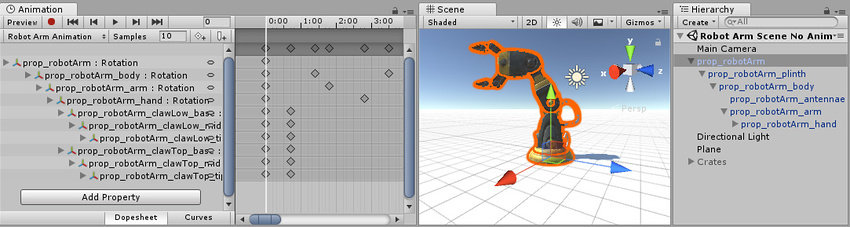
In the image below, the Animation view (left) shows the Animation used by the currently selected GameObject, and its child GameObjects if they are too controlled by this Animation. The Scene view and Bureaucracy view are on the right, demonstrating that the Animation view shows the Animations attached to the currently selected GameObject.
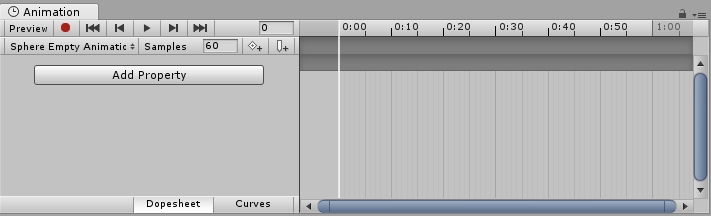
In the left side of the Animation view is a list of the animated properties. In a newly created clip where no animation has all the same been recorded, this list is empty.
When you begin to animate various properties within this clip, the blithe properties will appear hither. If the blitheness controls multiple child objects, the list will also include hierarchical sub-lists of each child object's animated properties. In the instance higher up, various parts of the Robot Arm's GameObject hierarchy are all animated inside the aforementioned blitheness clip.
When animative a bureaucracy of GameObjects within a single clip similar this, make sure yous create the Animation on the root GameObject in the bureaucracy.
Each property tin be folded and unfolded to reveal the exact values recorded at each keyframe. The value fields show the interpolated value if the playback caput (the white line) is between keyframes. You can edit these fields directly. If changes are made when the playback caput is over a keyframe, the keyframe's values are modified. If changes are made when the playback caput is betwixt keyframes (and therefore the value shown is an interpolated value), a new keyframe is created at that indicate with the new value that you entered.

The Blitheness Timeline
On the right side of the Animation View is the timeline for the current clip. The keyframes for each blithe property appear in this timeline. The timeline view has ii modes, Dopesheet and Curves. To toggle between these modes, click Dopesheet or Curve at the bottom of the blithe property list area:

These offering two alternate views of the Blitheness timeline and keyframe data.
Dopesheet timeline mode
Dopesheet mode offers a more compact view, allowing you to view each holding's keyframe sequence in an individual horizontal runway. This allows you to view a simple overview of the keyframe timing for multiple properties or GameObjects.
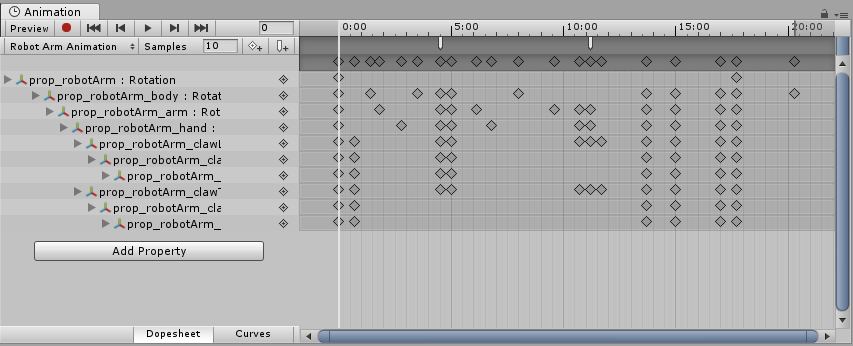
See documentation on Central manipulation in Dopesheet style for more data.
Curves timeline mode
Curves style displays a resizable graph containing a view of how the values for each animated property changes over time. All selected properties appear overlaid within the same graph view. This mode allows you to have keen command over viewing and editing the values, and how they are interpolated between.
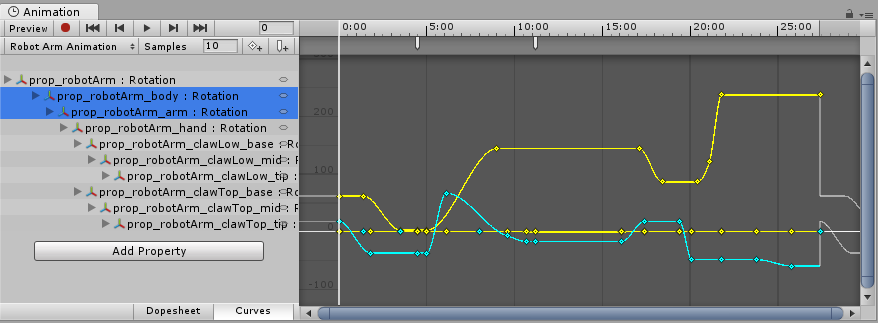
Fitting your option to the window
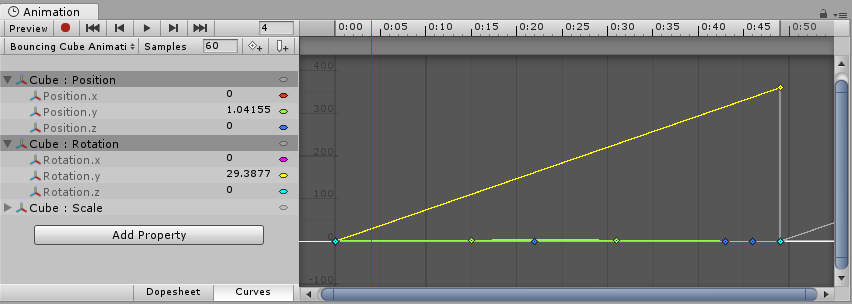
When using Curves manner to view your Blitheness, it'southward important to understand that sometimes the various ranges for each property tin can differ greatly. For instance, consider a simple Animation clip for a spinning bouncing cube. The bouncing Y position value may vary between the range 0 to ii (meaning the cube bounces 2 units loftier during the animation); still, the rotation value goes from 0 to 360 (representing its degrees of rotation). When viewing these ii curves at the aforementioned time, the blitheness curves Allows you lot to add data to an imported clip so you lot tin can animate the timings of other items based on the land of an animator. For example, for a game set in icy conditions, y'all could apply an extra animation bend to command the emission rate of a particle system to show the player'south condensing breath in the cold air. More info
See in Glossary for the position values will be very difficult to make out because the view volition exist zoomed out to fit the 0–360 range of the rotation values inside the window:
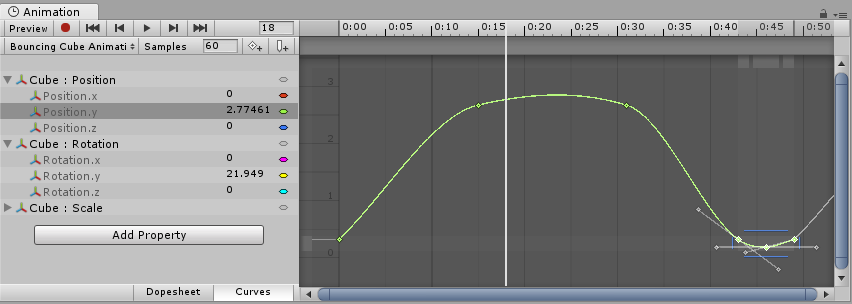
Printing F on the keyboard to zoom the view to the currently selected keyframes. This is useful every bit a quick way to focus and re-scale the window on a portion of your Animation timeline for easier editing.
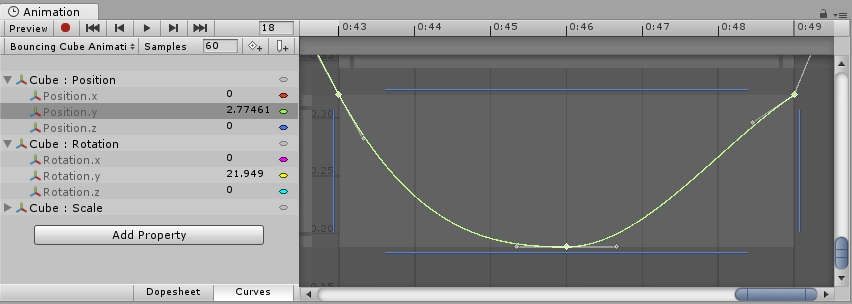
Click on individual properties in the list and press F on the keyboard to automatically re-calibration the view to fit the range for that value. Y'all can as well manually adapt the zoom of the Curves window by using the elevate handles at each end of the view'due south scrollbar sliders. In the image below, the Animation Window is zoomed in to view the bouncing Y position Animation. The first of the yellow rotation curve is still visible, simply at present extends manner off the top of the view:
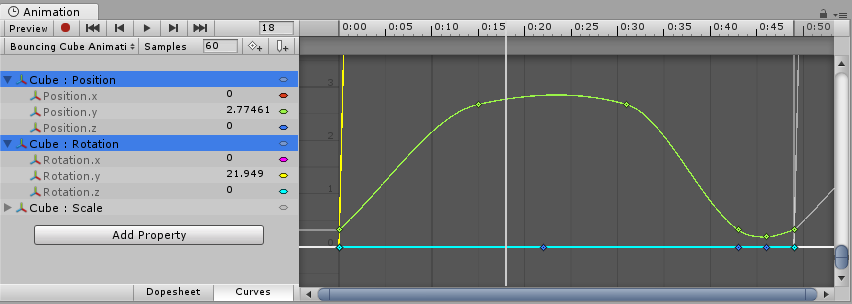
Printing A on the keyboard to fit and re-scale the window to prove all the keyframes in the prune, regardless of which ones are selected. This is useful if you want to view the whole timeline while preserving your current option:
Playback and frame navigation controls
To control playback of the Animation Prune, apply the Playback Controls at the elevation left of Animation view.

From left-to-right, these controls are:
- Preview mode (toggle on/off)
- Tape style (toggle on/off) Note: Preview mode is always on if record mode is on
- Move playback caput to the start of the clip
- Move playback head to the previous keyframe
- Play Animation
- Movement playback head to the side by side keyframe
- Move playback caput to the terminate of the clip
You tin besides control the playback head using the following keyboard shortcuts:
- Printing Comma (,) to go to the previous frame.
- Press Period (.) to go to the adjacent frame.
- Concur Alt and press Comma (,) to go to the previous keyframe A frame that marks the showtime or terminate point of a transition in an blitheness. Frames in between the keyframes are called inbetweens.
See in Glossary . - Concur Alt and printing Period (.) to become to the adjacent keyframe.
Locking the window
You tin lock the Animation editor window so that it does not automatically switch to reflect the currently selected GameObject in the Bureaucracy or Scene. Locking the window is useful if you lot want to focus on the Animation for ane particular GameObject, and however be able to select and manipulate other GameObjects in the Scene.

To acquire more than well-nigh navigating the Curve view, see documentation on Using Animation Curves.
- 2017–09–05 Page amended
Creating a new Blitheness Clip
hettingerantrume1988.blogspot.com
Source: https://docs.unity3d.com/Manual/animeditor-UsingAnimationEditor.html
0 Response to "One or More Selected Rahses Are Read-only Unity"
Post a Comment